



OpenAPI Diff · API Breaking Change Detection · Swagger Diff · Bi-Directional Contract Testing · Pact Alternative · can-i-deploy · GitHub PR Checks · CI/CD
SpecShield detects breaking API changes, runs contract tests, and gates deployments — directly in your CI/CD pipeline before they become production incidents.
OpenAPI diff + contract testing + bi-directional contracts + GitHub PR checks — in one CLI.
No broker. No complex setup. Works in 30 seconds.
APIs break silently. Your users feel it first.
- A backend developer renames a field — the mobile app crashes for 10,000 users
- An endpoint gets removed — the frontend breaks with no error in your logs
- A required field changes — partner integrations start failing at 2am
- You only find out after a production incident, a 3am alert, or an angry customer
Manual code review doesn't catch this. Integration tests run too late. You need a contract between your services — and something that enforces it.
Think of SpecShield as unit tests for your API contracts.
- The consumer declares what it expects from the provider
- The provider proves it satisfies those expectations before deploying
- SpecShield blocks the deployment if anything breaks
Consumer publishes contract → Provider verifies it → CI either passes or blocks
No runtime surprise. No production incident. No 3am page.
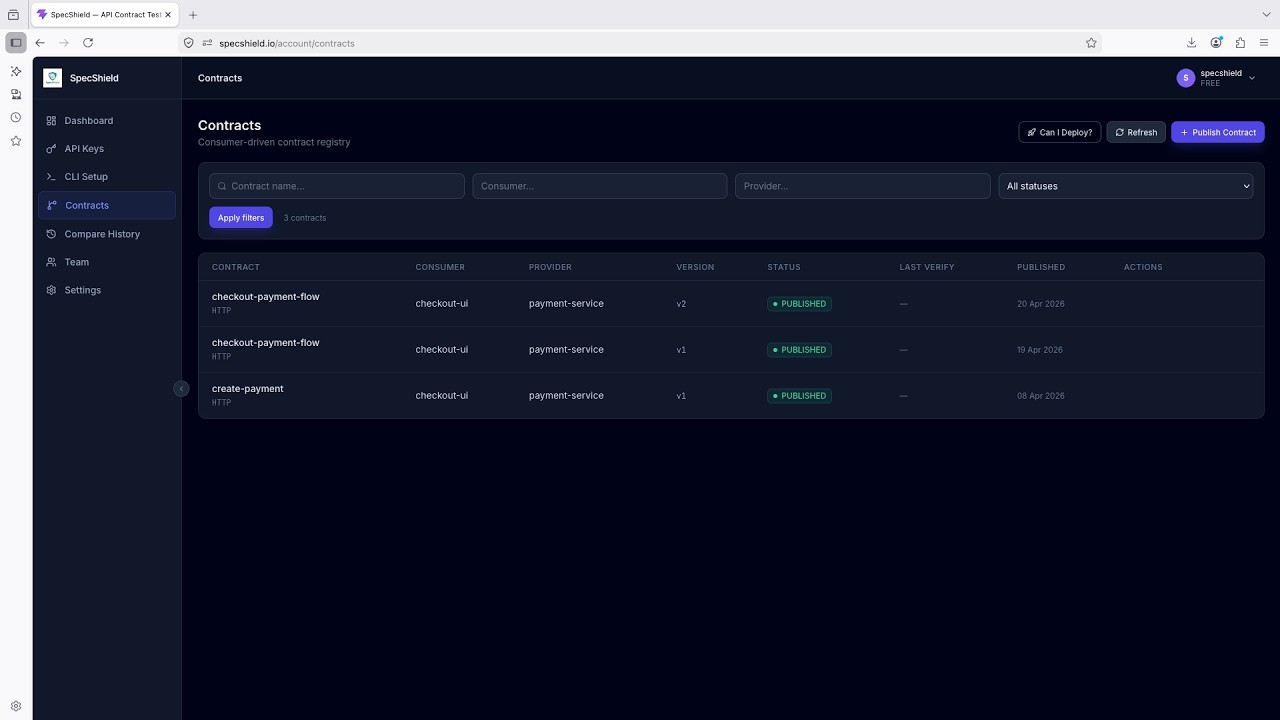
Watch: Catching a breaking API change before it hits production — compare specs, publish provider/consumer specs via BDCT, and gate deployments with
can-i-deploy.
CLI preview:
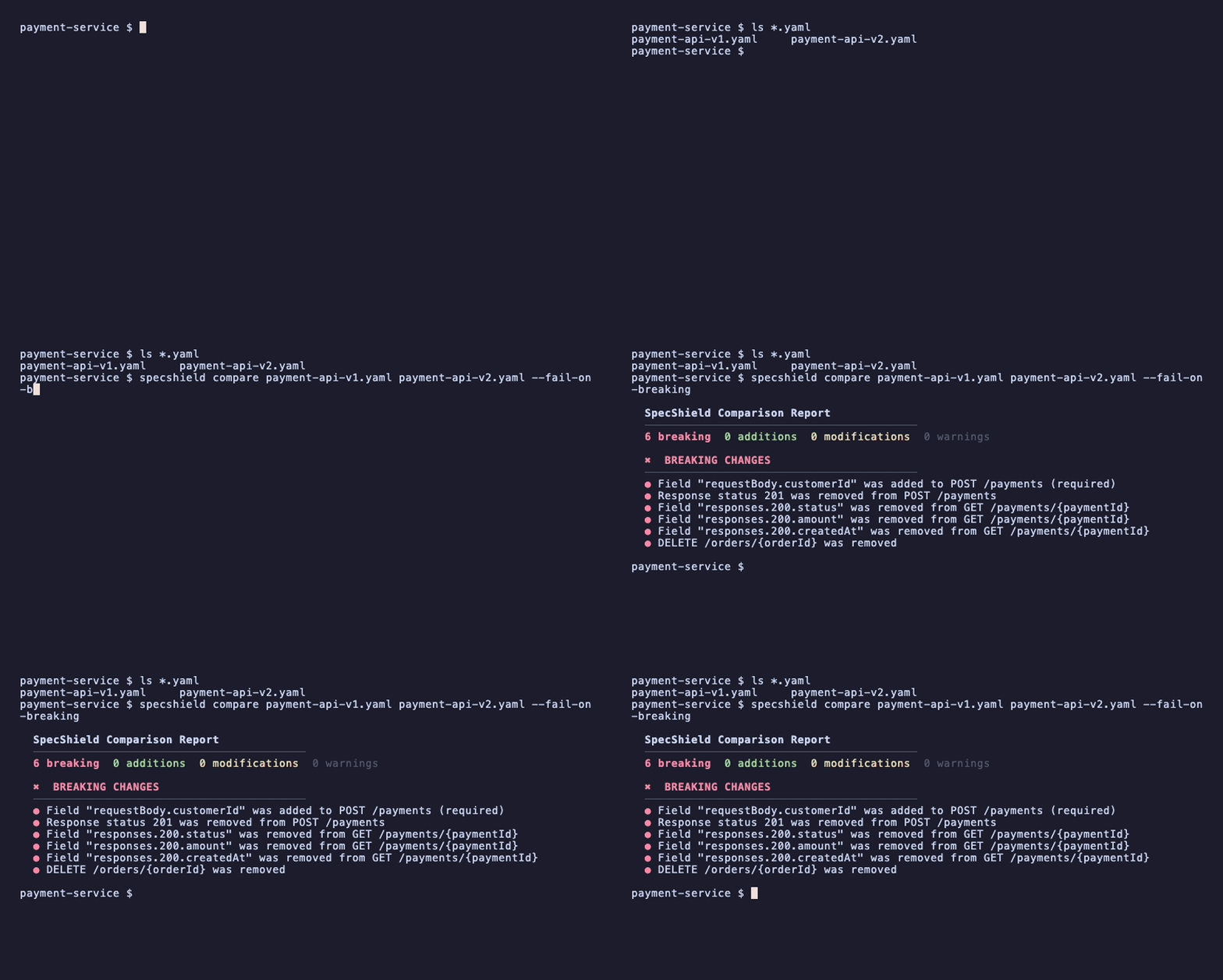
specshield compare payment-api-v1.yaml payment-api-v2.yaml --fail-on-breaking
$ specshield compare base.yaml target.yaml --fail-on-breaking

✖ BREAKING CHANGES DETECTED

  1. DELETE /users endpoint removed
  2. POST /payments — "amount" changed from optional to required
  3. GET /orders/{id} — "status" type changed: string → object

  Breaking changes : 3
  Modifications    : 1
  Additions        : 2

CI Result: FAILED  ·  Exit code: 1
That 3-line output just saved you a production incident.
And when everything is safe:
$ specshield compare base.yaml target.yaml --fail-on-breaking

✔ NO BREAKING CHANGES FOUND

  Breaking changes : 0
  Modifications    : 0
  Additions        : 3

CI Result: PASSED · Exit code: 0No account. No login. No config file. Just run it.
npm install -g specshieldspecshield compare base.yaml target.yaml --fail-on-breakingThat's it. Works with any OpenAPI 3.x YAML or JSON spec.
For BDCT, run the wizard once and never re-type the same flags again:
specshield initIt autodetects your OpenAPI spec, your service name (from package.json /
pyproject.toml / pom.xml / go.mod), your git branch, and your
default environment, asks you a few questions, and writes a
.specshield.yml at the project root. Every subsequent
specshield bdct ... invocation reads this file, so your CI commands
collapse to:
specshield bdct publish-provider --version $GITHUB_SHA
specshield bdct can-i-deploy --version $GITHUB_SHA
See § specshield init below.
Unlock history, dashboards, contract testing, and team features.
👉 Create free account at specshield.io
- ✅ No credit card required
- ✅ Takes less than 30 seconds
- ✅ GitHub and Google sign-in supported
- ✅ Local compare always free, forever
| Feature | Local (Free) | Cloud Free | Cloud Pro |
|---|---|---|---|
| Compare two spec files | ✅ | ✅ | ✅ |
| Breaking change detection | ✅ | ✅ | ✅ |
| JSON / human output | ✅ | ✅ | ✅ |
| Fail CI on breaking change | ✅ | ✅ | ✅ |
| Compare history & dashboard | ❌ | ✅ | ✅ |
| GitHub App PR checks | ❌ | ✅ | ✅ |
| BDCT bi-directional contracts | ❌ | ❌ | ✅ |
| BDCT can-i-deploy gating | ❌ | ❌ | ✅ |
| BDCT compatibility matrix | ❌ | ❌ | ✅ |
| Team collaboration | ❌ | ❌ | ✅ |
| API drift trends | ❌ | ✅ | ✅ |
The
payment-serviceteam merged a change that renamedstatustopaymentStatusin the payment creation response. Thecheckout-uiteam wasn't notified.Without SpecShield, this would have reached staging, broken checkout for every user, and triggered an incident at 2am.
With SpecShield, the provider's CI published the new spec via
specshield bdct publish-provider. The compatibility engine ran againstcheckout-ui's published contract and the mismatch was caught immediately:● MISSING_FIELD at $.status expected: "CREATED" → actual: null
can-i-deployreturned exit code1. The broken build never deployed. Zero users affected.
Pull Request Validation
Catch breaking changes before they're merged. Run specshield compare against your base branch on every PR.
CI/CD Gating
Fail the build automatically when a breaking change is detected. Exit code 1 triggers your pipeline to stop.
Microservices Contract Safety Consumer teams publish what they expect. Provider teams verify they deliver it. No cross-team surprises.
API Governance Track API drift over time across your entire platform. Know what changed, when, and which team changed it.
| Feature | SpecShield | Pact / Pactflow | openapi-diff |
|---|---|---|---|
| OpenAPI / Swagger native | ✅ | ❌ (code-level) | ✅ |
| No broker required | ✅ | ❌ (needs Pact Broker) | ✅ |
| Bi-directional contract testing | ✅ | ✅ (Pactflow paid) | ❌ |
| Breaking change detection | ✅ | ❌ | ✅ |
| can-i-deploy gating | ✅ | ✅ (via broker) | ❌ |
| GitHub App PR checks | ✅ | ❌ | ❌ |
| Pact JSON contract import | ✅ | ✅ | ❌ |
| Hosted dashboard | ✅ | ✅ (Pactflow, paid) | ❌ |
| Team collaboration | ✅ | ✅ (paid) | ❌ |
| CLI-first workflow | ✅ | ❌ | ✅ |
| Free hosted tier | ✅ | ❌ | N/A |
| Plan | Price | What's included |
|---|---|---|
| Free | $0 forever | Local compare (unlimited) · Compare history & dashboard · GitHub App PR checks |
| Pro | Coming soon | Everything in Free + BDCT bi-directional contracts · BDCT can-i-deploy & matrix · Team collaboration · Advanced reporting · Priority support |
No credit card ever required for the free plan. Get started free →
Step 1 — Create your account
Go to https://specshield.io · Sign in with GitHub or Google (30 seconds)
Step 2 — Generate an API key
Dashboard → API Keys → Generate Key · Copy the ss_ token
Step 3 — Authenticate the CLI
specshield login --api-key ss_your_token_here✔ Logged in successfully.
Customer : Your Name
Plan : FREE
Done. Your token is stored in ~/.specshield/config.json — no need to pass it on every command.
Or use an environment variable (recommended for CI):
export SPECSHIELD_API_KEY=ss_your_token_hereThis single env var works for every command — compare, login, and every
bdct subcommand all read it.
Token resolution order:
compare/login:--api-keyflag →SPECSHIELD_API_KEYenv var → stored config →.specshield.ymlbdct ...subcommands:--api-tokenflag →SPECSHIELD_API_KEYenv var → stored config
Why two flag names?
compareandloginwere built first and used--api-key. The newerbdctcommands use--api-tokento keep the word "key" reserved for the stored config concept. The env var unifies both.
No account needed.
# Basic compare
specshield compare base.yaml target.yaml

# Fail CI on breaking changes
specshield compare base.yaml target.yaml --fail-on-breaking

# JSON output
specshield compare base.yaml target.yaml --json

# Save to file
specshield compare base.yaml target.yaml --output result.json

# Ignore a specific change
specshield compare base.yaml target.yaml --ignore "DELETE /admin removed" --fail-on-breakingSends your specs to SpecShield and stores results in your dashboard. Requires a free account and API key.
# Remote compare
specshield compare base.yaml target.yaml --remote

# Remote + fail on breaking
specshield compare base.yaml target.yaml --remote --fail-on-breaking

# Remote + JSON output saved to file
specshield compare base.yaml target.yaml --remote --json --output result.jsonAutomatic API contract checks on every pull request — no workflow YAML required.
Install the SpecShield GitHub App once and every PR that touches your OpenAPI spec gets:
- A GitHub check run (pass/fail) visible directly on the PR
- A PR comment with the full diff table — breaking changes highlighted in red
- Configurable
fail-on-breakingper repository
- Go to Dashboard → GitHub Integration at specshield.io
- Click Install GitHub App
- Choose the repositories to enable (or select all)
- Done — no secrets, no workflow changes needed
When a PR is opened or updated, SpecShield:
- Fetches the OpenAPI spec from the base branch and the PR branch
- Runs the same diff engine as
specshield compare - Posts a GitHub check run — Passed if no breaking changes, Failed if breaking changes found
- Adds a PR comment with the full breakdown:
## SpecShield API Contract Check

| Change | Type | Severity |
|--------|------|----------|
| POST /payments — "amount" required field added | Request schema | BREAKING |
| GET /orders/{id} — "status" type changed | Response schema | BREAKING |
| GET /users — new query param "filter" | Addition | NON-BREAKING |

Breaking changes: 2 · Non-breaking: 1
Add a .specshield.yml to your repo root:
github:
  specPath: api/openapi.yaml   # path to your spec (default: openapi.yaml)
  failOnBreaking: true         # block PR merge on breaking changes (default: true)
commentOnPr: true # post breakdown comment (default: true)- The spec file must exist on both the base branch and the PR branch
- Supported formats: OpenAPI 3.x YAML or JSON
- The GitHub App needs
pull_requests: writeandchecks: writepermissions (granted during install)
Run once at the root of your project. The wizard:
- Detects your OpenAPI spec (looks under
api/,spec/,docs/, repo root). - Detects your service name (
package.json,pyproject.toml,pom.xml,go.mod,Cargo.toml, or directory name). - Detects your git branch and suggests
productionformain/master,stagingotherwise. - Asks whether this project is a provider, a consumer, or both.
- Asks for your org key (autocompletes from your account if you're already signed in).
- Validates / stores your API key.
- Writes
.specshield.ymland, optionally, a starter.github/workflows/specshield-bdct.ymlthat usesspecshield26/bdct-action@v1.
specshield initschemaVersion: 1
failOnBreaking: true
severity: error
bdct:
org: acme-pay
environment: staging
provider:
name: payment-service
spec: api/openapi.yaml
# consumer (optional — present when --kind=consumer or --kind=both):
# consumer:
# name: checkout-ui
# provider: payment-service
# contract: contracts/payment-service.yaml
# format: OPENAPI
github:
specPath: api/openapi.yaml
failOnBreaking: true
commentOnPr: trueCLI flags always override this file. Paths in the file are resolved
relative to the file's own directory, so you can run specshield bdct ...
from any subdirectory of your project.
# Provider-only project
specshield init --no-interactive \
  --kind     provider \
  --org      acme-pay \
  --provider payment-service \
  --spec     api/openapi.yaml \
  --env      staging \
  --write-workflow

# Consumer-only project
specshield init --no-interactive \
  --kind              consumer \
  --org               acme-pay \
  --consumer          checkout-ui \
  --consumer-provider payment-service \
  --contract          contracts/payment-service.yaml \
  --format            OPENAPI \
--env staging| Flag | Purpose |
|---|---|
--no-interactive |
Run without prompts; all required fields must come from flags or package.json/git autodetection. |
--print |
Detect everything, print the proposed YAML to stdout, write nothing. Good for --dry-run review in CI. |
--force |
Skip the overwrite-confirmation if .specshield.yml already exists. |
--server <url> |
Use a non-default SpecShield endpoint (self-hosted / staging). Default: https://specshield.io. |
--kind <kind> |
provider, consumer, both, or skip. Required in --no-interactive. |
--org <key> |
Organization key. |
--provider <name> |
Provider service name (used when `--kind=provider |
--spec <path> |
Path to the provider OpenAPI spec. |
--consumer <name> |
Consumer service name (used when `--kind=consumer |
--consumer-provider <name> |
The provider this consumer talks to (used when `--kind=consumer |
--contract <path> |
Path to the consumer contract (OpenAPI or Pact JSON). |
--format <fmt> |
Consumer contract format: OPENAPI (default) or PACT. |
--env <environment> |
Default environment for BDCT operations. |
--write-workflow |
Also write a starter GitHub Actions workflow under .github/workflows/specshield-bdct.yml. |
What is not written into
.specshield.yml: your API key. It is stored in~/.specshield/config.json(set byspecshield login) or read fromSPECSHIELD_API_KEYin CI. The project file is meant to be committed; never commit a secret into it.
Spec-to-spec contract testing — no running services required.
Both sides publish their OpenAPI specs. SpecShield compares them and flags mismatches immediately — ideal for teams that don't run services locally or in CI. Pact JSON consumer contracts are also accepted and auto-converted.
BDCT requires a Pro plan. Upgrade at specshield.io/upgrade
- Consumer team publishes an OpenAPI spec subset (the endpoints they use)
- Provider team publishes their full OpenAPI spec
- SpecShield compares them: endpoint presence, request schemas, response fields, status codes, types
can-i-deploygates the deployment — returns0only when all consumers are compatible
specshield bdct publish-provider \
  --org acme-store \
  --provider payment-service \
  --version v2.1.0 \
  --spec ./api/openapi.yaml \
  --env production \
  --branch main
✔ Provider Spec Published
─────────────────────────────────────────────────────
ID : 1842
Provider : payment-service
Version : v2.1.0
Environment : production
Published At: 2026-05-13 14:30:12
Verifications triggered: 3
--branch is optional — when present it's stamped on the published spec so you
can correlate a spec version with the git branch it came from in
bdct list-providers.
The consumer contract is an OpenAPI spec that describes only the endpoints the consumer uses:
# consumer-contract.yaml — only the subset checkout-ui uses
openapi: "3.0.0"
info:
  title: checkout-ui → payment-service contract
  version: "1.0.0"
paths:
  /payments:
    post:
      requestBody:
        content:
          application/json:
            schema:
              type: object
              required: [orderId, amount, currency]
              properties:
                orderId: { type: string }
                amount:  { type: number }
                currency: { type: string }
      responses:
        "201":
          content:
            application/json:
              schema:
                type: object
                properties:
                  paymentId: { type: string }
                  status:    { type: string }
specshield bdct publish-consumer \
--org acme-store \
--consumer checkout-ui \
--provider payment-service \
--version 2.0.0 \
--contract ./contracts/checkout-ui-payment.yaml \
--format OPENAPI ✔ Consumer Contract Published
─────────────────────────────────────────────────────
ID : 942
Consumer : checkout-ui
Provider : payment-service
Version : 2.0.0
Format : OPENAPI
Published At: 2026-05-13 14:31:05
Verifications triggered: 1
➜ Run: specshield bdct verify --consumer checkout-ui --provider payment-service
If the provider spec is already published, compatibility is verified automatically — the "Verifications triggered" count reflects that.
Pact JSON contracts are also supported — pass --format PACT and point
--contract at a Pact file. The backend stores the format and runs the same
compatibility engine against your provider's OpenAPI spec:
specshield bdct publish-consumer \
  --org acme-store \
  --consumer checkout-ui \
  --provider payment-service \
  --version 2.0.0 \
  --contract ./pacts/checkout-ui-payment-service.json \
  --format PACT
--format defaults to OPENAPI if omitted.
Manually trigger a verification between a specific consumer/provider pair:
specshield bdct verify \
  --org acme-store \
  --consumer checkout-ui \
  --consumer-version 2.0.0 \
  --provider payment-service \
  --provider-version v2.1.0 \
  --env production
Compatible output:
  ✔  COMPATIBLE

  Endpoints checked: 2
  Compatible       : 2
  Incompatible     : 0
Incompatible output:
  ✖  INCOMPATIBLE

  Endpoints checked: 2
  Compatible       : 1
  Incompatible     : 1

  Issues
  ● POST /payments [ERROR] RESPONSE_FIELD_MISSING
    field: $.status
    Consumer expects it — provider spec does not return it

  ● GET /payments/{id} [WARNING] TYPE_MISMATCH
    field: $.amount
    consumer: integer  →  provider: string
specshield bdct can-i-deploy \
  --org acme-store \
  --service payment-service \
  --version v2.1.0 \
  --env production
Deployable output:
  ✔  PASS: payment-service v2.1.0 is deployable in production
  ─────────────────────────────────────────────────────

  Consumer Verifications

  Consumer     Version  Status      Verified At
  ───────────  ───────  ──────────  ───────────────
  checkout-ui  2.0.0    COMPATIBLE  2026-05-13 14:32
  mobile-app   1.5.0    COMPATIBLE  2026-05-13 14:32
  partner-sdk  3.2.1    COMPATIBLE  2026-05-13 14:32
Blocked output:
  ✖  FAIL: payment-service v2.1.0 is NOT deployable in production
  ─────────────────────────────────────────────────────

  Consumer Verifications

  Consumer     Version  Status        Verified At
  ───────────  ───────  ────────────  ───────────────
  checkout-ui  2.0.0    INCOMPATIBLE  2026-05-13 14:32
  mobile-app   1.5.0    INCOMPATIBLE  2026-05-13 14:32

  ➜  Run: specshield bdct verify --consumer <NAME> --provider payment-service
  ➜  to identify and resolve incompatibilities
Exit codes: 0 = deployable · 1 = blocked · 2 = error
View the compatibility status across all consumer/provider pairs in your org:
specshield bdct matrix --org acme-store --env production BDCT Compatibility Matrix
Environment: production
─────────────────────────────────────────────────────
Consumer \ Provider payment-service order-service
─────────────────── ─────────────── ─────────────
checkout-ui COMPATIBLE COMPATIBLE
mobile-app INCOMPATIBLE COMPATIBLE
partner-sdk COMPATIBLE UNKNOWN
■ COMPATIBLE ■ INCOMPATIBLE ■ UNKNOWN
# All providers for the org
specshield bdct list-providers --org acme-store

# Filter by provider name
specshield bdct list-providers --org acme-store --provider payment-service
Published Provider Specs
─────────────────────────────────────────────────────
Showing 3 of 3 specs
ID Provider Version Environment Branch Published At
──── ─────────────── ─────── ─────────── ────── ───────────────
1842 payment-service v2.1.0 production main 2026-05-13 14:30
1799 payment-service v2.0.0 staging main 2026-04-20 09:11
1772 order-service v1.3.0 production main 2026-04-28 11:02
# All consumers for the org
specshield bdct list-consumers --org acme-store

# Filter by consumer or provider
specshield bdct list-consumers --org acme-store --consumer checkout-ui
specshield bdct list-consumers --org acme-store --provider payment-servicespecshield bdct list \
--org acme-store \
--provider payment-service \
--env production \
--page 0 \
--size 20 BDCT Verification History
─────────────────────────────────────────────────────
Showing 2 of 2 verifications
ID Consumer Provider Cons Ver Prov Ver Status Environment Verified At
──── ─────────── ─────────────── ──────── ──────── ──────────── ─────────── ───────────────
3081 checkout-ui payment-service 2.0.0 v2.1.0 COMPATIBLE production 2026-05-13 14:32
3082 mobile-app payment-service 1.5.0 v2.1.0 INCOMPATIBLE production 2026-05-13 14:32
All BDCT commands support --json for CI parsing:
specshield bdct can-i-deploy --org acme-store --service payment-service --version v2.1.0 --json{
"deployable": false,
"service": "payment-service",
"version": "v2.1.0",
"environment": "production",
"reason": "payment-service v2.1.0 is INCOMPATIBLE with: checkout-ui@2.0.0 (INCOMPATIBLE)",
"verifications": [
{
"consumerName": "checkout-ui",
"consumerVersion": "2.0.0",
"status": "INCOMPATIBLE",
"compatibleCount": 1,
"incompatibleCount": 1
}
]
}# 1. Provider publishes spec on every release
specshield bdct publish-provider \
--org acme-store --provider payment-service \
--version v2.1.0 --spec ./api/openapi.yaml
# 2. Each consumer publishes their contract once (update on contract change)
specshield bdct publish-consumer \
--org acme-store --consumer checkout-ui \
--provider payment-service --version 2.0.0 \
--contract ./contracts/checkout-ui.yaml
# 3. Gate the provider deployment
specshield bdct can-i-deploy \
--org acme-store --service payment-service \
--version v2.1.0 --env productionname: API Contract Check
on:
pull_request:
branches: [main]
jobs:
check-api-contract:
runs-on: ubuntu-latest
steps:
- uses: actions/checkout@v4
with:
fetch-depth: 0
- uses: actions/setup-node@v4
with:
node-version: '20'
- run: npm install -g specshield
- name: Get base spec
run: git show origin/main:api/openapi.yaml > /tmp/base.yaml
- name: Compare specs
run: specshield compare /tmp/base.yaml api/openapi.yaml --fail-on-breakingname: BDCT Publish Provider Spec
on:
push:
branches: [main]
paths:
- 'api/openapi.yaml'
jobs:
publish-bdct:
runs-on: ubuntu-latest
steps:
- uses: actions/checkout@v4
- uses: actions/setup-node@v4
with:
node-version: '20'
- run: npm install -g specshield
- name: Publish provider spec
env:
SPECSHIELD_API_KEY: ${{ secrets.SPECSHIELD_API_KEY }}
run: |
specshield bdct publish-provider \
--org ${{ vars.SPECSHIELD_ORG }} \
--provider payment-service \
--version ${{ github.sha }} \
--spec ./api/openapi.yaml \
--env production
- name: Gate deployment
env:
SPECSHIELD_API_KEY: ${{ secrets.SPECSHIELD_API_KEY }}
run: |
specshield bdct can-i-deploy \
--org ${{ vars.SPECSHIELD_ORG }} \
--service payment-service \
--version ${{ github.sha }} \
--env productionname: BDCT Publish Consumer Contract
on:
push:
branches: [main]
paths:
- 'contracts/bdct/**'
jobs:
publish-consumer:
runs-on: ubuntu-latest
steps:
- uses: actions/checkout@v4
- uses: actions/setup-node@v4
with:
node-version: '20'
- run: npm install -g specshield
- name: Publish consumer contract
env:
SPECSHIELD_API_KEY: ${{ secrets.SPECSHIELD_API_KEY }}
run: |
specshield bdct publish-consumer \
--org ${{ vars.SPECSHIELD_ORG }} \
--consumer checkout-ui \
--provider payment-service \
--version ${{ github.ref_name }} \
--contract ./contracts/bdct/checkout-ui-payment.yamlRun specshield init to generate
.specshield.yml automatically, or hand-write it. Either way, every
specshield ... invocation reads the file from the project root (or any
parent directory) and uses its values as defaults — CLI flags always win.
The full schema supports both local-compare defaults and BDCT defaults:
schemaVersion: 1

# Local-compare defaults (used by `specshield compare`).
failOnBreaking: true
severity: error                  # info | warning | error
ignore:
  - "DELETE /admin removed"      # match by substring; repeatable

# Hosted compare (set --remote on the CLI to override).
remote:
  enabled: false
  url: https://specshield.io/compare
  timeout: 10000
  # apiKey is intentionally NOT set here. Use SPECSHIELD_API_KEY in CI
  # or `specshield login` locally. Never commit a key to a file.

# BDCT defaults (used by every `specshield bdct ...` subcommand).
bdct:
  org: acme-pay
  environment: staging
  # server: https://specshield.io   # only set for self-hosted / staging

  provider:
    name: payment-service
    spec: api/openapi.yaml          # paths are relative to this file
    # branch: main                  # informational tag on each publish

  # consumer:
  #   name: checkout-ui
  #   provider: payment-service
  #   contract: contracts/payment-service.yaml
  #   format: OPENAPI               # OPENAPI | PACT

# GitHub App + bdct-action defaults.
github:
  specPath: api/openapi.yaml
  failOnBreaking: true
  commentOnPr: true
When this file is present, BDCT commands collapse to just --version:
specshield bdct publish-provider --version $GITHUB_SHA
specshield bdct can-i-deploy --version $GITHUB_SHAspecshield compare <base> <target> [options]| Option | Description |
|---|---|
--remote |
Use the SpecShield hosted API |
--api-key <key> |
API token |
--fail-on-breaking |
Exit code 1 on breaking changes |
--allow-breaking |
Override fail-on-breaking |
--json |
Machine-readable JSON output |
--output <file> |
Save result to file |
--ignore <change> |
Ignore a specific change (repeatable) |
--severity <level> |
info / warning / error |
--config <path> |
Path to .specshield.yml |
--timeout <ms> |
Request timeout for remote mode |
specshield bdct <subcommand> [options]| Subcommand | Description |
|---|---|
publish-provider |
Publish a provider OpenAPI spec |
publish-consumer |
Publish a consumer contract (OpenAPI subset or Pact JSON) |
verify |
Manually trigger verification for a consumer/provider pair |
can-i-deploy |
Check if a service version is safe to deploy |
matrix |
Compatibility matrix across all consumer/provider pairs |
list-providers |
List published provider specs |
list-consumers |
List published consumer contracts |
list |
List verification history |
Every bdct subcommand accepts these flags in common:
| Flag | Purpose |
|---|---|
--org <key> |
Organization key (or read from .specshield.yml's bdct.org) |
--json |
Machine-readable JSON output |
--server <url> |
Override SpecShield server URL (self-hosted / staging) |
--api-token <token> |
API token (overrides env / stored config) |
Per-subcommand flags:
| Subcommand | Flags |
|---|---|
publish-provider |
--spec <path>, --provider <name>, --version <ver>, --env <env>, --branch <branch> |
publish-consumer |
--contract <path>, --consumer <name>, --provider <name>, --version <ver>, --format OPENAPI|PACT |
verify |
--consumer <name>, --provider <name>, --consumer-version <ver>, --provider-version <ver>, --env <env> |
can-i-deploy |
--service <name>, --version <ver>, --env <env> |
matrix |
--env <env> |
list-providers |
--provider <name> (filter) |
list-consumers |
--consumer <name> (filter), --provider <name> (filter) |
list |
--consumer <name>, --provider <name>, --env <env>, --page <n>, --size <n> |
| Code | Meaning |
|---|---|
0 |
Clean — no breaking changes / deployable |
1 |
Breaking changes found / not deployable |
2 |
Config error, missing token, or runtime error |
MIT © Deepak Satyam
Questions or issues?
⭐ Star on GitHub · 📦 View on npm · 🚀 Create free account
Stop finding out about API breakage from your users.